
 Image 1 of 1
Small Harbor Publishing, 2025.
WINNER OF THE HARBOR EDITIONS 2023 LAUREATE PRIZE, JUDGED BY MAYA WILLIAMS.
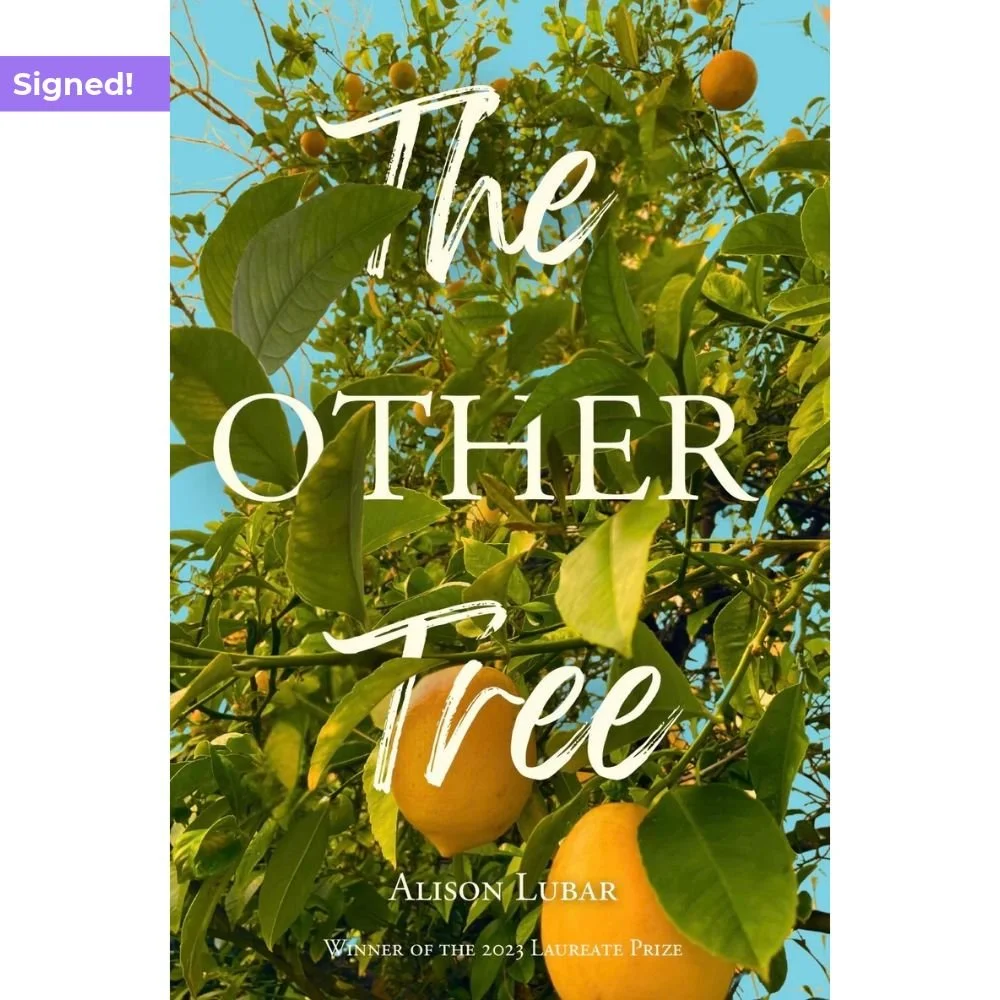
The Other Tree, winner of the 2024 Laureate Prize and Alison Lubar’s second full-length poetry collection, is grounded in their family’s story of imprisonment during the Japanese Internment. From the lemon tree in Auntie Masae’s backyard and its perennial fruit, the California sunshine and the Pennsylvania winters, the desolation of Tule Lake Relocation Center and the abundance of their mother’s suburban kitchen, these poems offer a story that spans cross-country and ninety-five years, and remains rooted in transgenerational healing.
Through free verse, haibun, prose poetry, sonnet, some formal and others not, The Other Tree’s poems are curated with a year and location to contextualize both chronologically and thematically. Since healing isn’t linear, these poems are circular in their curation and exploration of time, spanning Tacoma Washington in 1930 to Oakland California today, and follow the relationships among Lubar’s Ojisan, Auntie Masae, mother, and great-grandmother, Shizuko.
This collection also reflects Lubar’s own mixed-race and queer (nonbinary, sapphic, femme) identity. The Other Tree considers the complexity of love and redemption, how human relationships, like emotions, never exist in a binary. It considers the “other” of the “family tree,” and how one source of roots can produce so much varied, healing growth.
Praise for The Other Tree:
Reading Alison Lubar’s The Other Tree is like looking through a family album and watching the people come to life, start talking, and—in listening, closely and carefully, to each other, and in light of Lubar’s exquisite attention—keep growing. These poems reanimate the past, recover what has been lost, and redeem what has been broken; they are the finding and the freeing of oneself in the roots and the shade of the “ancestral sanctuary of uncollected leaves.”
— Brandon Shimoda, author of The Afterlife Is Letting Go
The Other Tree blooms from an ancestral place of wild strawberries. I’m in awe of Lubar’s fearlessness and tenderness; each poem in this magnificent collection is infused with the sensory fullness that our memories deserve. At once inquisitive and cutting, The Other Tree summons the voices of strong aunties, traumatized uncles, and other family members who survived confinement to live on as ghosts. Here is a poet who leans into the haunting, transmutes rage, reclaims power. This book reminds me that history is a branching thing, its vines and tributaries anchoring us to a past both painful and triumphant. — Brynn Saito, author of Under a Future Sky
